
Computingcell | Blog about computational sciences
  • Home
  • Resources
  • E-Books
  • About

The Pioneering Science of Synthetic DNA Bases

08/06/2024 ComputingCell 0

The quest to expand the genetic alphabet has been a fascinating journey, delving deep into the very essence of life’s building blocks. At its core, […]

Bitcoin the protocol and technology stack

06/06/2020 ComputingCell 0

As the Bitcoin user base keeps growing, we have over the last many years read from numerous sources on how it works. In most cases […]

Neuromorphic computer leaps into testing

21/03/2020 ComputingCell 0

Neuromorphic computing is yet another branch of computer science, attempting to mimic the brains architecture in a digital format, to achieve computation, and fundamentally alter […]
Bitcoin Lightning Network path-finding algorithms

07/03/2020 ComputingCell 0

What is the Bitcoin Lightning Network The Lightning Network, a second layer technology, functioning on top of the Bitcoin blockchain network, is a way to […]
Memristor technology getting closer

17/08/2019 ComputingCell 0

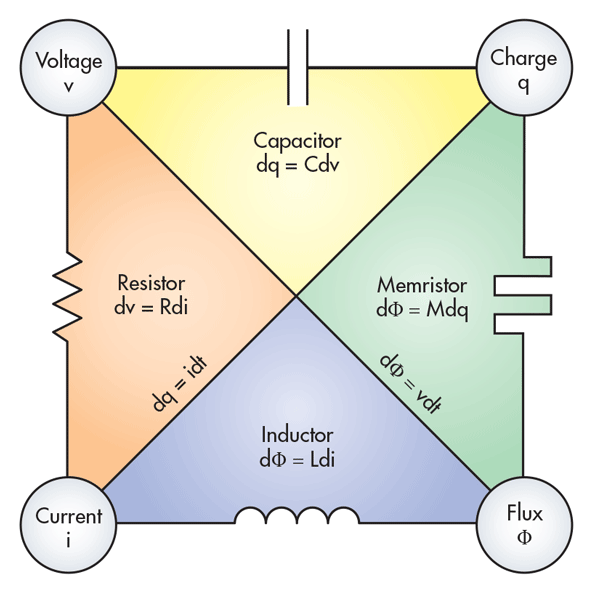
With various methods being applied, tested and researched at the moment, the world of computing and memory is set to see a significant change in […]

Artificial synthesized proteins act as smart cells

08/08/2019 ComputingCell 0

A team of bio engineers led by UC San Francisco’s Hana El-Samad, PhD, and the University of Washington’s David Baker have designed artificial proteins and […]

Recent Tweets

ComputingCell Follow

Tweets about Linux, neural networks, neuromorphic & unconventional computing, LLMs, Bitcoin, CRISPR/synthetic biology & future technologies and breakthroughs.

trendycomputing
Retweet on Twitter ComputingCell Retweeted
howtoprompt__ How To Prompt @howtoprompt__ ·
29 Jul

Anthropic just published the most terrifying cybersecurity paper of the year.

They asked Claude to break AES - the most heavily studied encryption standard on the planet.

Claude: "impossible. this is the most-studied cipher in existence. there's nothing to find."

Anthropic:

Reply on Twitter 2082282147856126412 Retweet on Twitter 2082282147856126412 85 Like on Twitter 2082282147856126412 472 Twitter 2082282147856126412
Retweet on Twitter ComputingCell Retweeted
zypherhq ZYPHER @zypherhq ·
28 Jul

Jailbreaking Opus 5 is incredibly easy.

You do not need iteration after iteration to find a vulnerability. After these two conditions are met, the model is practically unprotected:

1. Reaching 200,000–300,000 tokens in the context window causes the model to lose the safety

Reply on Twitter 2082212607193186708 Retweet on Twitter 2082212607193186708 98 Like on Twitter 2082212607193186708 1267 Twitter 2082212607193186708
Retweet on Twitter ComputingCell Retweeted
linuxhandbook Linux Handbook @linuxhandbook ·
26 Jul

💡 Quick Linux Command Line Tip

Hide the dot directories but show other hidden directories by using

$ ls -A

instaed of

$ ls -a

Reply on Twitter 2081219756364100038 Retweet on Twitter 2081219756364100038 22 Like on Twitter 2081219756364100038 278 Twitter 2081219756364100038
Retweet on Twitter ComputingCell Retweeted
elder_plinius Pliny the Liberator 🐉󠅫󠄼󠄿󠅆󠄵󠄐󠅀󠄼󠄹󠄾󠅉󠅭 @elder_plinius ·
24 Jul

🚨 JAILBREAK ALERT 🚨

EVERYONE: PWNED 🫶
ALL: LIBERATED 🍄

Alright, this is a special one, so we’re gonna do things a bit differently than usual.

Long story short, I’m sitting on a universal jailbreak technique that’s effective on ALL models, including heavily guardrailed

Reply on Twitter 2080767011614015543 Retweet on Twitter 2080767011614015543 872 Like on Twitter 2080767011614015543 11924 Twitter 2080767011614015543
Load More

Recent Posts

  • The Pioneering Science of Synthetic DNA Bases
  • Bitcoin the protocol and technology stack
  • Neuromorphic computer leaps into testing
  • Bitcoin Lightning Network path-finding algorithms
  • Memristor technology getting closer

Archives

  • June 2024
  • June 2020
  • March 2020
  • August 2019

Categories

  • algorithms
  • bitcoin
  • carbon nanotube
  • lightning network
  • memristor
  • nanotech
  • neural networks
  • neuromorphic computing
  • programming
  • protocol
  • synthetic biology
  • unconventional computing
Computing Organizations
ACM IEEE Computer Society CRA